
Tariffs have moved from the margins of trade policy to the center of business decision making. For companies importing into the United States or operating across the U.S.-Mexico border, the impact is no longer limited to customs calculations. Tariffs are affecting margins, contracts, sourcing decisions, cash flow, and how companies assess risk across their supply chains.
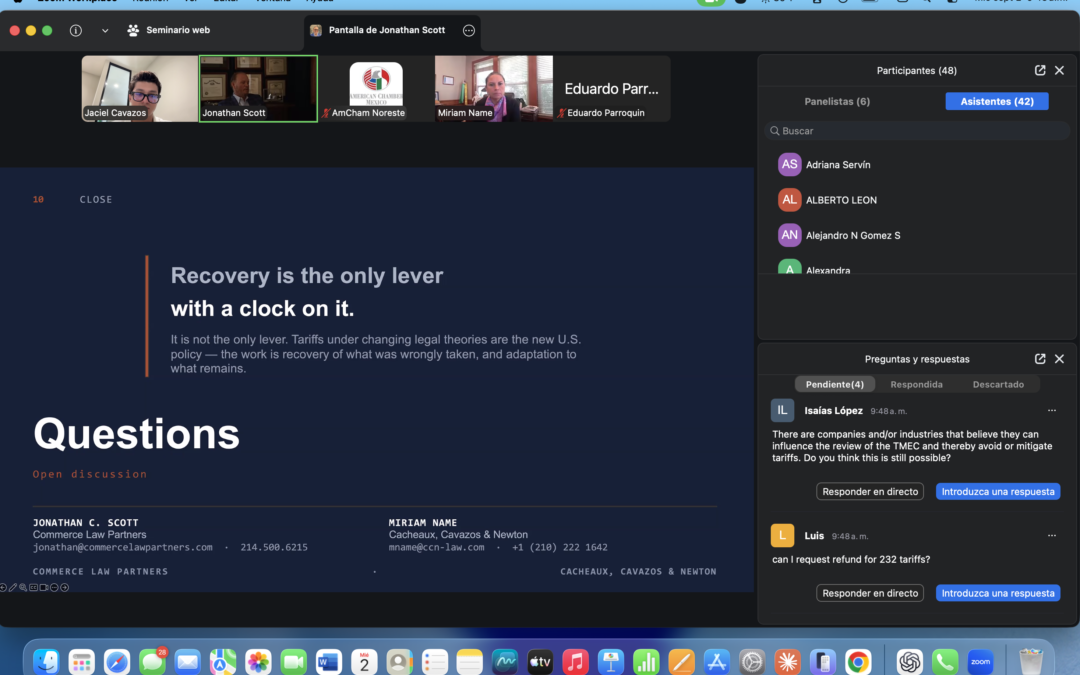
This changing environment framed the discussion during “Tariffs Took the Margin: Can Importers Get It Back?”, a joint session organized by the Foreign Trade and Logistics Committee and the Rule of Law Committee of the AMERICAN CHAMBER OF COMMERCE OF MEXICO, Northeast Chapter. The conversation featured Jonathan C. Scott, Chief of Strategy at Commerce Law Partners, whose practice focuses on federal litigation, international trade, and cross-border commerce, and Miriam Name, Partner at Cacheaux, Cavazos & Newton, who specializes in international trade, customs, and tariff compliance. The session examined both sides of the current challenge: recovering duties already paid and preparing for a trade environment in which tariff authorities and enforcement mechanisms continue to evolve.
One of the main takeaways was that companies should not treat the recent tariff measures as a single regime. Since 2025, different authorities have been used successively, including the International Emergency Economic Powers Act (IEEPA), Section 122, Section 301, and Section 232. Each operates under a different legal framework and can produce different rates, procedures, exemptions, and recovery options. The practical implication is significant: identifying the duties a company paid is only the first step; it is equally important to determine the legal authority under which each duty was imposed.
This distinction became particularly important following the U.S. Supreme Court’s February 2026 ruling that IEEPA does not authorize the President to impose tariffs. In response, U.S. Customs and Border Protection established the Consolidated Administration and Processing of Entries (CAPE) process for eligible IEEPA duty refunds. Through CAPE, trade users may submit multiple eligible entry numbers through a single declaration and request consolidated processing. However, CAPE currently processes most entries that remain unliquidated or are no more than 80 days past their liquidation date.
The existence of an administrative refund process does not mean that every potentially recoverable entry is automatically eligible. Eligibility may depend on factors such as liquidation status, entry type, protests, injunctions, classification, valuation, reconciliation, and other procedural conditions. A claim accepted into the system also represents a processing status rather than, by itself, a final determination that payment will be issued.
For importers, this creates a need for a more disciplined review of historical entries. Companies must be able to determine which transactions fall within the current CAPE framework, which require further analysis, and which may be affected by deadlines or procedural limitations outside the portal. The materials presented during the session underscored that CAPE can be an effective mechanism for qualifying entries, but it may not represent the complete recovery strategy in every case.
The discussion also made clear that tariff recovery cannot be separated from USMCA compliance. For goods of Mexican origin, preferential treatment depends on the importer’s ability to document and substantiate origin. As emphasized during the presentation, duty-free treatment should not be viewed merely as a status claimed at entry, but as a position that must be supported by the underlying documentation. At the same time, sector-specific tariffs affecting products such as steel, aluminum, copper, vehicles, and auto parts may operate independently from USMCA preferences.
This evolving environment is also changing the role of customs documentation within companies. Certifications of origin, tariff classification, valuation, importer-of-record structures, and supporting records are no longer isolated compliance requirements. They increasingly form part of a broader commercial strategy because weaknesses in any of these areas can affect both the ability to recover past duties and the ability to defend preferential treatment on future entries.
The session therefore moved beyond the question of refunds and identified a broader set of actions available to companies. The framework presented included five areas: recovering duties already paid, strengthening origin qualification, reviewing contracts and entry structures, using lawful mechanisms to mitigate duty exposure, and monitoring new investigations, appeals, and tariff authorities. The underlying message was clear: recovery addresses the past, but adaptation will determine the extent to which a company remains exposed in the future.
This approach also requires greater coordination across the organization. Trade compliance cannot manage tariff exposure alone. Legal teams must evaluate available remedies and preserve rights; finance must understand potential recovery and continuing exposure; procurement and supply-chain teams must review sourcing and origin; and commercial teams must consider how tariff costs affect pricing, contracts, and customer relationships.
The recent evolution of U.S. tariff policy also demonstrates why companies should avoid planning on the assumption that a single court decision will restore a previous trade environment. The session materials showed how different statutory authorities continued to be used as earlier measures were challenged or replaced. The relevant question for companies is therefore not only whether a particular tariff will remain in effect, but what authority may follow it and how quickly the business can respond.
For companies engaged in North American trade, resilience will increasingly depend on the quality of the information behind each transaction. Entry-level visibility, defensible origin documentation, clear contractual responsibilities, and timely monitoring of legal and regulatory developments can provide companies greater flexibility to react before the next policy change reaches their margins.
The immediate opportunity is to determine what may still be recovered from past entries. The longer-term challenge is to prevent the same exposure from being recreated in future shipments.
Tariff recovery is therefore not only about recovering funds. It is about understanding the source of the cost, preserving the rights and remedies currently available, and building a trade strategy capable of adapting to future developments.
AMERICAN CHAMBER/MEXICO
Monterrey, Nuevo León | (09 | 09 | 2026)